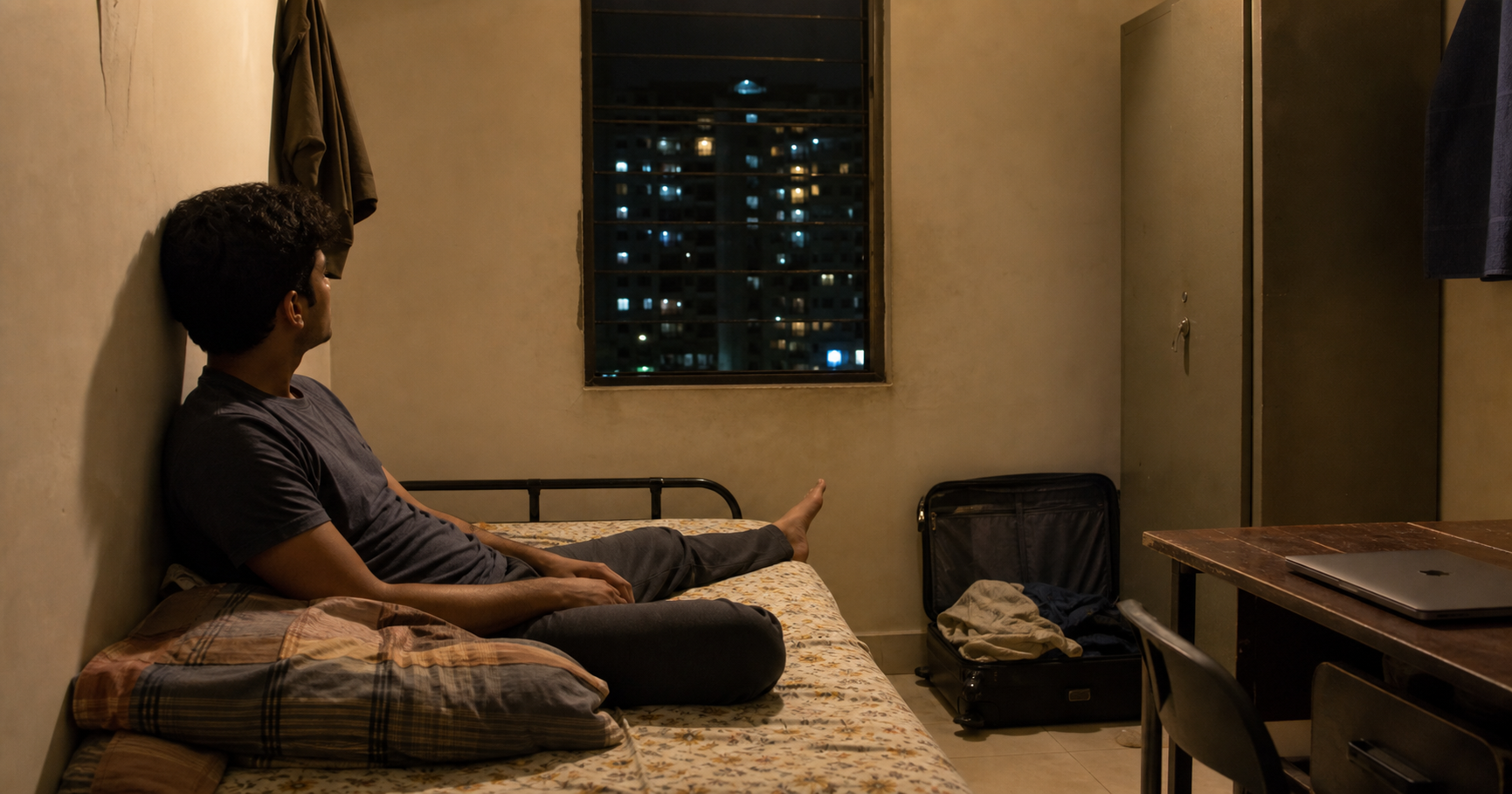
The first week feels like an adventure. You landed in a city you picked because the offer letter said so. You found a PG in Koramangala or a 1BHK in HSR Layout through a broker who charged you a month's rent for a five minute phone call. You set up your room. Bought a pillow from DMart. Put your clothes in a steel almirah that smells like the last person who lived here.
Week one is fine. You're busy. There's onboarding at office, forms to fill, ID cards to collect, a team lunch where everyone asks where you're from and what you studied. You smile a lot. You eat lunch with people whose last names you'll forget by Friday. You take an auto home, order dinner from Swiggy, and call your parents to tell them sab theek hai.
By week three, the adventure has worn off. The auto routes are familiar. The Swiggy orders repeat. The team lunch conversations have run out of surface level questions. And one evening, sitting in your room at 9:30 PM with nothing particular to do and no one particular to call, you feel it.
Not sadness, exactly. Something flatter. A silence that takes up more space than it should.
The city of first timers
Bangalore is unlike any other Indian city in one specific way: almost nobody here is from here. It's a city built almost entirely on people who moved in from somewhere else. From Patna, Ranchi, Bhopal, Lucknow, Coimbatore, Kochi. Everyone came for work. Everyone left behind the people they grew up with.
That makes Bangalore strangely democratic in its loneliness. The person in the next cubicle is going through the same thing. The guy at the gym who nods at you every morning is going through the same thing. The girl at the chai stall near your office who eats alone and reads her phone, same thing.
But here's what nobody tells you before you move: being surrounded by other lonely people doesn't make you less lonely. If anything, it normalizes the loneliness so thoroughly that you stop recognizing it as a problem. You think this is just what adult life feels like. Everyone seems to be managing. So you manage too.
Office, gym, groceries, Swiggy, sleep. Repeat. Surrounded by eight million people. Genuinely connected to maybe two or three. And even those two or three are colleagues you'd lose track of if either of you switched jobs.
The friends you left behind are still your friends. But differently.
Your college group chat is still active. Someone posts a reel every other day. Birthdays get wished. But the conversations have shifted. They're performative now. Memes, screenshots, reaction emojis. The group chat is alive but nobody in it is actually talking.
And the friends who do call, the real ones, they're in their own version of this. One is in Hyderabad dealing with the same empty evenings. One is in Pune trying to figure out if this is what they signed up for. One stayed back in your hometown and is living a life you can't relate to anymore because your worlds have diverged too far.
You still love these people. But the version of you that they know is six months out of date. You've changed in ways that are hard to explain over a phone call. You've started questioning things you didn't question before. You've felt things you didn't know how to name. And the gap between who you are now and who they think you are is growing wider every week.
So when you call them, you perform. You talk about work, traffic, weekend plans. You don't mention the silence. Because mentioning it would require an explanation, and the explanation would require a vulnerability that the phone call format doesn't support.
Why the loneliness spikes after 9 PM
During the day you're fine. The office gives you a structure, a role, a reason to be somewhere. Colleagues give you enough surface interaction to keep the silence at bay. You eat lunch with people. You sit in meetings. You write code or answer emails or present slides. The doing keeps you occupied.
But the commute home is where it starts. The BMTC bus or the metro or the Rapido ride back to your flat. You take off your earphones and the city sounds fade and you're left with just your own thoughts for the first time since morning.
By 9 PM the structure is gone. You're in your room. You've eaten. You've scrolled. You've opened WhatsApp and closed it. Twice. And now there's nothing between you and the feeling you've been outrunning all day.
This is when 56% of working professionals in Indian cities admit to feeling lonely. Not during office hours. After. When the performance stops and the room gets quiet.
A survey across 14 companies found that another 23% feel it but won't admit it. So we're looking at nearly 8 in 10 young professionals carrying something they can't say out loud, in cities they moved to voluntarily, doing jobs they worked hard to get.
The loneliness isn't despite the success. It's woven into it.
The PG room, the 1BHK, and the silence
There's a specific kind of quiet that exists in a rented room in an Indian city when you're living alone for the first time.
It's not the quiet of your childhood bedroom, which was punctuated by your mother's voice from the kitchen or the TV in the living room or your sibling arguing on the phone. That was a full silence, a silence surrounded by life.
This silence is hollow. It's the sound of a room that nobody else enters. Where the only notifications are from Zomato asking if you want to reorder last night's biryani. Where the walls don't know your name.
You fill it with content. YouTube on autoplay. A podcast you're half listening to. Music that serves as background noise rather than something you chose. You don't want entertainment. You want the absence of quiet. Because the quiet makes you think, and thinking leads you to the question you've been avoiding: is this really it?
Not in a dramatic, existential way. More in a Tuesday night way. A "I have no one to tell about the small thing that happened today" way. A "something funny happened at lunch and I have no one to share it with tonight" way.
Nobody teaches you how to be alone in a new city
School taught you calculus. College taught you data structures. Your parents taught you how to cook dal and do laundry, maybe. LinkedIn told you how to negotiate your CTC.
Nobody taught you how to sit with yourself at 10 PM in a city where you know zero people and not spiral. Nobody taught you how to process the specific grief of choosing ambition over proximity, of being 800 kilometers from the people who make you feel like yourself.
And nobody told you that this is a completely normal, completely common experience that millions of people your age are going through in this exact city at this exact hour.
That's the cruelest part. You think you're the only one staring at the ceiling at 11 PM wondering if you made the right call. You're not. The person in the PG room next to yours is doing the same thing. But neither of you will say it, because you've both been taught that managing alone is what adults do.
What would actually help
You don't need a therapist. What you're feeling isn't a disorder. It's displacement. You moved your body to a new city but your emotional support system is still in the old one, and the gap between the two is where the silence lives.
You don't need an AI chatbot either. A bot can't understand what it feels like to eat dal chawal alone for the fourteenth night in a row while your roommate's phone plays a show you can hear through the wall.
What you need is simple and specific: a real person to talk to tonight. Someone who doesn't need your backstory. Someone who isn't going to tell you to join a meetup group or download a hobby app. Someone who's just there, on the other end, at 10:30 PM when the room gets too quiet.
Not forever. Just tonight. And then maybe again next Thursday when the same feeling shows up.
That's not weakness. That's what being 24 in a new city actually requires: a place to say the thing you can't say to your team lead or your PG roommate or your parents on the 8 PM call.
A place where the silence finally has an answer.
Haven connects you with a real person to talk to, by chat or call, whenever you need to be heard. No therapy. No AI. Just a real conversation.
Download on the App Store · Get it on Google Play