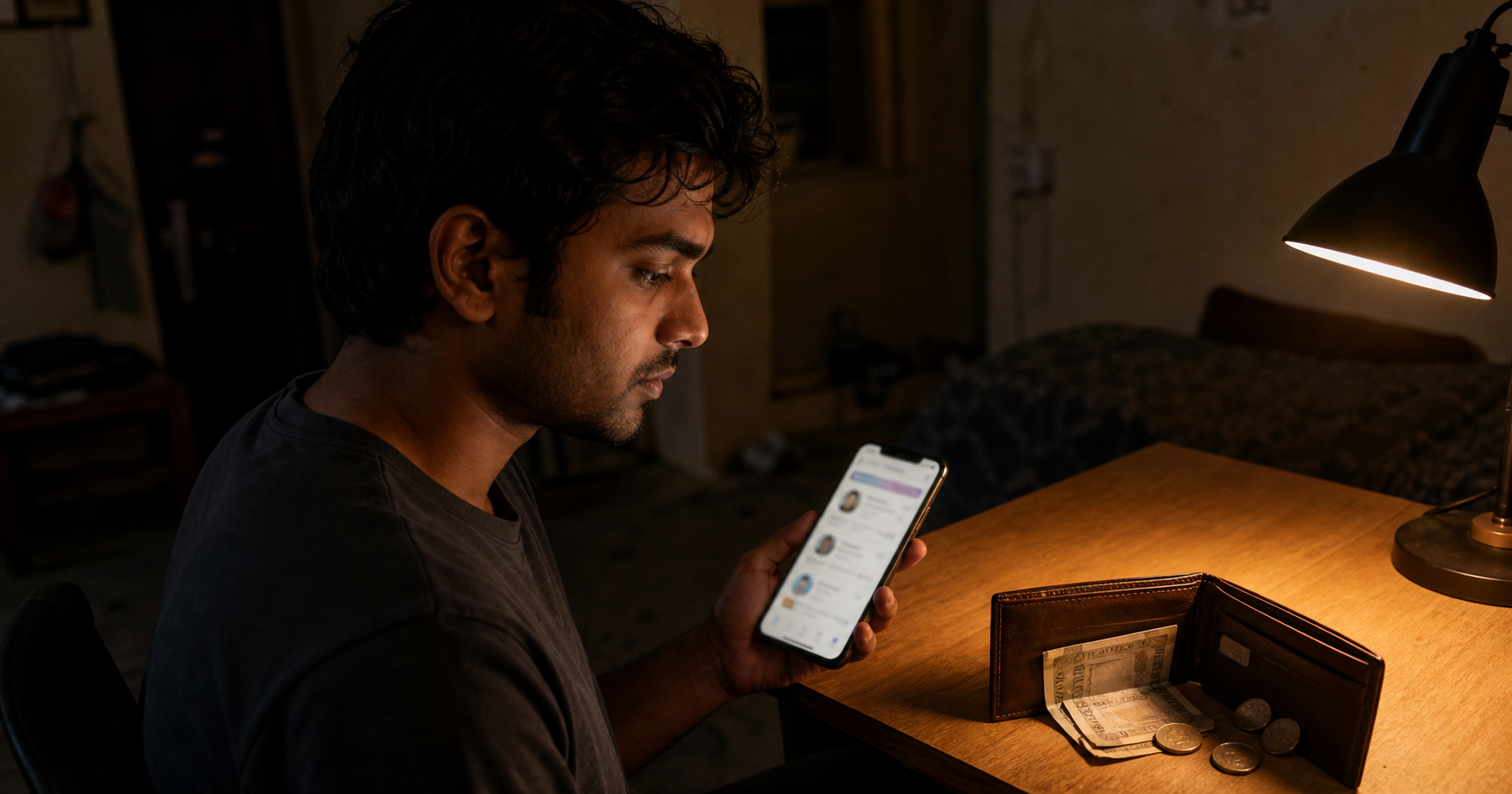
Let's do the math that nobody does before recommending therapy.
A decent therapist in Bangalore, Mumbai, or Delhi charges between ₹1,500 and ₹3,000 per session. Let's take the middle: ₹2,000. Therapists generally recommend weekly sessions, at least in the beginning. That's ₹8,000 a month.
The average starting salary for a software engineer in India is around ₹4 to ₹6 lakh per year. Take home after taxes, PF, and deductions is roughly ₹30,000 to ₹40,000 a month. Rent in any metro city takes ₹8,000 to ₹15,000. Food, transport, phone bill, the basics eat another ₹8,000 to ₹10,000.
₹8,000 a month for therapy is 20 to 25 percent of what's left. For someone in their early twenties, that's not a decision. That's a financial impossibility.
And that's the math for someone with a tech salary. For the person working in content, in sales, in operations, in retail, in any of the hundreds of roles that start below ₹25,000 a month, the conversation about therapy never even begins.
The recommendation everyone gives, nobody follows
"Have you considered therapy?"
You've heard it. On Instagram, on LinkedIn, from that one friend who did therapy and now thinks everyone should. It's become the default response to any emotional disclosure. Feeling stuck? Therapy. Can't sleep? Therapy. Fighting with your parents? Therapy. Vaguely sad on a Sunday evening? Therapy.
The word has become a full stop. A way to close a conversation rather than open one. Someone tells you they're struggling and instead of sitting with them in it, you hand them a referral. It feels responsible. It feels caring. And it ends your obligation to be present.
But here's the part that gets skipped: when you tell a 23 year old earning ₹28,000 a month to "try therapy," you're essentially telling them to solve an emotional problem with money they don't have. The advice isn't wrong in principle. It's wrong in context. And when advice is wrong in context, it doesn't help. It isolates. Because now the person feels like the solution exists but is locked behind a paywall they can't clear, which makes them feel worse than before the recommendation.
What therapy actually is (and isn't)
Let's separate the signal from the noise.
Clinical therapy is a structured, evidence based intervention delivered by a trained professional. It uses specific modalities like CBT, DBT, psychodynamic therapy, EMDR. It's designed for diagnosable conditions: clinical depression, generalized anxiety disorder, PTSD, OCD, personality disorders. It involves assessment, treatment planning, and measurable outcomes. It is medical care for the mind.
It's also, genuinely, transformative for the people who need it. If you're experiencing persistent symptoms that interfere with your ability to function, therapy can change your life. That's not in question.
What's in question is the assumption that every form of emotional distress requires this level of intervention.
Because most of what people carry at midnight isn't a clinical condition. It's the weight of a life that doesn't have enough honest conversations in it. It's the accumulation of unsaid things. It's the gap between how you present yourself and how you actually feel, widening a little more every week. None of this requires a diagnosis. All of it requires a listener.
The free options that exist and why they don't work
India has helplines. KIRAN, iCall, Vandrevala Foundation, Tele-MANAS, Samaritans Mumbai. These are real, staffed by real people, and genuinely free. They serve an essential function for people in crisis.
But they're designed for crisis. The framing, the phone trees, the intake questions, they're built for someone who is in immediate distress. If you call a helpline and say "I'm not suicidal, I'm just lonely and I wanted to talk," you'll get a kind response, but the infrastructure wasn't built for that conversation. You'll feel like you're taking up space meant for someone who needs it more.
Then there are apps. AI chatbots that generate empathetic responses. They're free, they're available at 2 AM, and they respond instantly. But anyone who's tried having a real emotional conversation with a chatbot knows the ceiling. It can mirror your language. It can validate your feelings with perfectly worded sentences. What it can't do is pause. It can't be surprised by what you said. It can't share a moment of silence where both of you sit in the heaviness of something that doesn't have a solution. It can't say "yeah, that happened to me too" and mean it.
The free options exist on two extremes: crisis intervention and artificial intelligence. In between, where most people live, there's nothing. Or more precisely, there's nothing that costs ₹0.
What ₹0 should actually get you
Let's describe what would need to exist for the gap to be filled.
A real person. Not a recording, not a script, not an algorithm trained on therapy transcripts. A human being who is awake, present, and listening.
Available at night. Not 9 AM to 5 PM. Not "office hours." At 11 PM, at 1 AM, at the exact hour when the silence becomes unbearable and every other option is asleep or offline.
No intake forms. No "on a scale of 1 to 10, how are you feeling?" No diagnostic questionnaire before you're allowed to speak. Just a space to say what's there, in whatever words come out, without having to translate your feelings into clinical language first.
No social consequences. Someone who doesn't know your name, your family, your job, your neighbourhood. Someone the "log" can never reach. Someone whose only function is to hear what you need to say and hold it without turning it into gossip, advice, or a diagnosis.
No timer. Not a 50 minute session that starts with "so, what brings you here today?" and ends with "our time is up, let's pick this up next week." A conversation that lasts as long as the conversation needs to last.
That's a lot to ask for ₹0. But it's exactly what millions of people need and don't have access to right now. Someone real, someone safe, someone available, at the hour they actually need it, without the price tag that turns a basic human need into a luxury product.
The uncomfortable truth about affordability
Here's what nobody in the mental health industry says out loud: making therapy cheaper doesn't solve the problem for most people. Because most people don't need therapy. They need a conversation.
Therapy is a specialized tool for specific conditions. It requires years of training, clinical supervision, and continuous education. It should cost what it costs because the expertise is real and valuable. Arguing that therapy should be free is like arguing that surgery should be free. The skill deserves compensation.
But we've created a culture where therapy is the only socially acceptable response to emotional pain, and then priced it out of reach for the majority of the population. So millions of people sit in the gap. They know they need to talk to someone. They can't afford the someone who has credentials. And they've been taught that any other form of emotional support is inferior, unqualified, or dangerous.
That framing is the problem. Not every conversation about feelings needs a degree on the wall. Not every heavy night needs a treatment plan. Sometimes all you need is a real person who will listen without trying to fix you, and you need them to be available tonight, not two weeks from now when the therapist has an opening.
That's not a replacement for therapy. It's a replacement for the silence that fills the gap when therapy isn't an option.
Haven connects you with a real person to talk to, by chat or call, whenever you need to be heard. No therapy. No AI. Just a real conversation.
Download on the App Store · Get it on Google Play