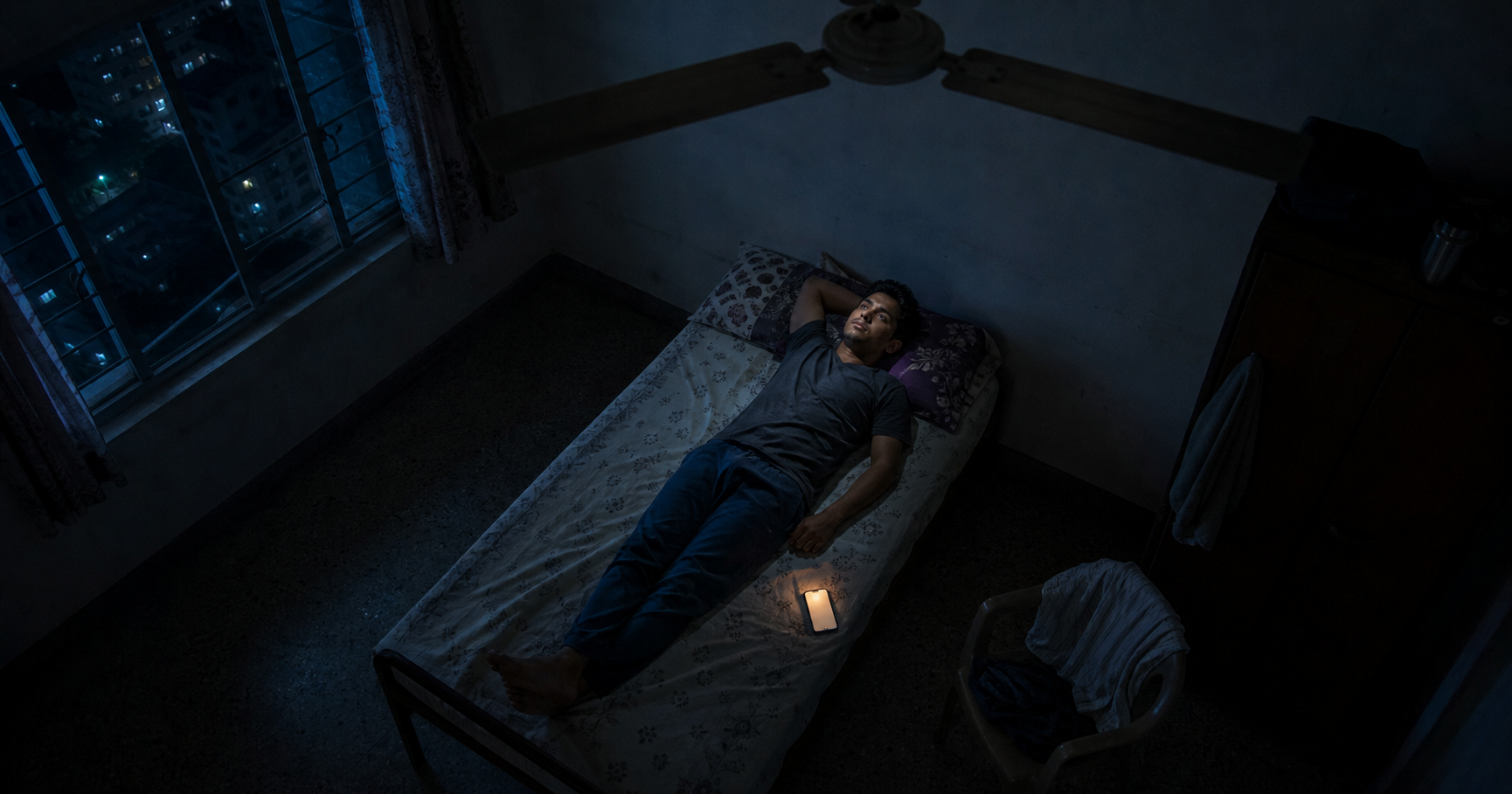
You weren't planning to be awake at 2 AM.
It started normally enough. You got into bed around 11. Scrolled Instagram for a bit. Watched half a reel, then another, then seventeen more without noticing. Somewhere around midnight you put the phone down, turned over, and waited for sleep.
Sleep didn't come.
Instead, your brain did the thing it does when the room goes quiet and there's nothing left to distract it. It pulled up a conversation from last week you wish you'd handled differently. Then a decision from last year you're still not sure about. Then a version of your future that you're afraid might be the real one. One thought connected to the next, and the next, and now it's 2 AM and your eyes are open and the ceiling has become the most familiar surface in your life.
You picked up your phone again. Not to call anyone. It's 2 AM. You can't call anyone at 2 AM. You just held it. Like holding something solid might make the thoughts weigh less.
If you know this sequence, keep reading. Because what's happening at 2 AM isn't random. And understanding why it happens won't fix it, but it might stop you from thinking something is wrong with you.
Your brain works differently after midnight
This isn't a metaphor. Your brain literally processes emotions differently at night.
Cortisol, the hormone that helps you manage stress and regulate emotional responses, follows a daily cycle. It peaks in the morning, giving you the energy and resilience to deal with whatever the day throws at you. By late evening it starts dropping. By 2 AM it's at its lowest point.
What this means in practical terms: the thing that felt manageable at 3 PM, a comment from your boss, a message from an ex, a worry about your career, feels entirely different at 2 AM. Not because the thing changed. Because your capacity to hold it without spiraling has been chemically reduced.
Your brain isn't broken at 2 AM. It's running the same hardware with less fuel. And when the fuel runs low, the thoughts that your daytime brain keeps filed away under "deal with later" start leaking out.
Researchers call this rumination. The clinical term for the loop your brain gets stuck in when there's nothing external to anchor it. At night, without work or conversation or movement to redirect attention, rumination takes over. It's not a choice. It's what brains do when the distractions stop and the cortisol drops.
Why the phone makes it worse
You already know this, but let's say it anyway.
The instinct at 2 AM is to reach for the phone. Not to do anything specific. Just to interrupt the loop. Give the brain something, anything, other than its own thoughts.
But here's what actually happens: you scroll through content you don't care about. You see people posting highlights of their lives while you're lying in the dark questioning yours. You open WhatsApp and see last seen timestamps that confirm everyone else is asleep, which makes you feel more alone than you did before you opened it.
A study of over 16,000 Indian young adults found that people who used their phones for more than two hours before bed had significantly higher rates of sleep problems. Not just delayed sleep. Poor sleep quality, irregular patterns, and more night awakenings. The phone doesn't interrupt the spiral. It adds a backlit screen to it.
And the specific pattern of late night scrolling in India has its own rhythm. The content shifts after midnight. Reels get more emotional. Stories get more vulnerable. The whole tone of social media changes because the people posting at 2 AM are the same people who are awake at 2 AM for the same reason you are. You're consuming loneliness content made by lonely people, and the algorithm is smart enough to keep feeding it to you because your engagement metrics spike when you're emotionally raw.
The silence that has weight
There's a specific quality to 2 AM silence in an Indian city that's different from any other hour.
At 10 PM the city is still alive. Autos honking. Neighbours talking. The uncle downstairs watching news at a volume that suggests he thinks the newsreader can hear him too. There's enough ambient life to make your room feel like part of a world.
By 2 AM that's gone. The street is empty. The building is quiet. The only sound is the fan or the AC or your own breathing. And in that silence, the room shrinks. The distance between you and the nearest person who knows you exist feels measurable.
If you're in a PG, the silence has a specific cruelty. You can hear the person in the next room shifting on their mattress. They're five feet away through a wall. They might be awake too. But neither of you will say anything, because that's not how PG life works. You share a kitchen and a bathroom and a WiFi password. You don't share what's keeping you awake.
If you're in a 1BHK alone, the silence is different. It's bigger. It fills every room equally. The kitchen you didn't cook in tonight. The living room where the TV is off. The bathroom where you stood under the shower an hour ago and let the water run longer than necessary because at least the sound was something.
What you're actually looking for at 2 AM
Let's strip it down to what's really happening.
You're awake. Your brain is running a highlight reel of every unresolved thing in your life. Your cortisol is at its daily low. The phone has made it worse. The silence is making it worse than that.
What you want, the actual thing, is a voice. Not a voice note. Not a reply to a story. Not a podcast host talking at you through earphones. A live human voice that's talking to you, that knows you're there, that's responding to the specific thing you just said.
Or even just a chat. Just someone typing back in real time. Not a bot generating text. A person choosing their words, pausing, thinking about what you said. The rhythm of a real conversation, where sometimes the other person takes a few seconds to respond because they're actually considering what you told them.
That's what 2 AM needs. Not content. Not advice. Not a sleep meditation that asks you to imagine a peaceful lake while your brain is replaying the thing your father said at dinner last Diwali.
A person.
The 2 AM problem has a structural cause
Here's what nobody talks about: the reason 2 AM is so lonely isn't just biological. It's structural.
Indian social life is built around daytime and evening hours. Chai at 4 PM. Dinner with friends at 8. Phone calls with parents at 9. The entire support system operates between roughly 7 AM and 11 PM. After that, the system shuts down. Not because people stop caring. Because they're asleep.
But emotional distress doesn't follow office hours. The brain doesn't check the clock before starting a spiral. The worst feelings in your life are not going to wait until 10 AM when it's socially acceptable to call someone.
And for young people living alone in cities, the structural gap is even wider. Their parents are two time zones of lifestyle away, asleep by 10:30. Their friends are in the same situation, awake but unreachable because calling someone at 2 AM carries weight. It implies crisis. And what you're feeling isn't a crisis. It's a Tuesday. It's a regular, recurring, predictable pattern of nighttime loneliness that doesn't qualify as an emergency but feels unbearable in the moment.
2 AM doesn't have to be a dead end
The reason this hour feels like a wall is because every support option you can think of is unavailable. Friends are asleep. Parents are asleep. Therapists don't take sessions at 2 AM. Helplines feel like overkill for what you're feeling. You're not in danger. You're just alone with your thoughts and no one to interrupt them.
But the fact that this is the pattern, the same sequence every few nights, same spiral, same phone, same ceiling, means the problem isn't spontaneous. It's predictable. And predictable problems can have designed solutions.
A real person, awake, available, chosen for how you talk, with no history and no judgement, at the exact hour when the cortisol drops and the silence gets heavy. Not an emergency resource. Not a therapist billing by the minute. Just someone to break the loop at the moment the loop is strongest.
That's not a luxury. For the 56% of working professionals who admit to feeling lonely, and the 23% who feel it but won't say it, that's infrastructure. As basic as the WiFi in your PG. Something that should exist because the alternative, staring at the ceiling until exhaustion wins, isn't a system. It's an absence of one.
Haven connects you with a real person to talk to, by chat or call, whenever you need to be heard. No therapy. No AI. Just a real conversation.
Download on the App Store · Get it on Google Play