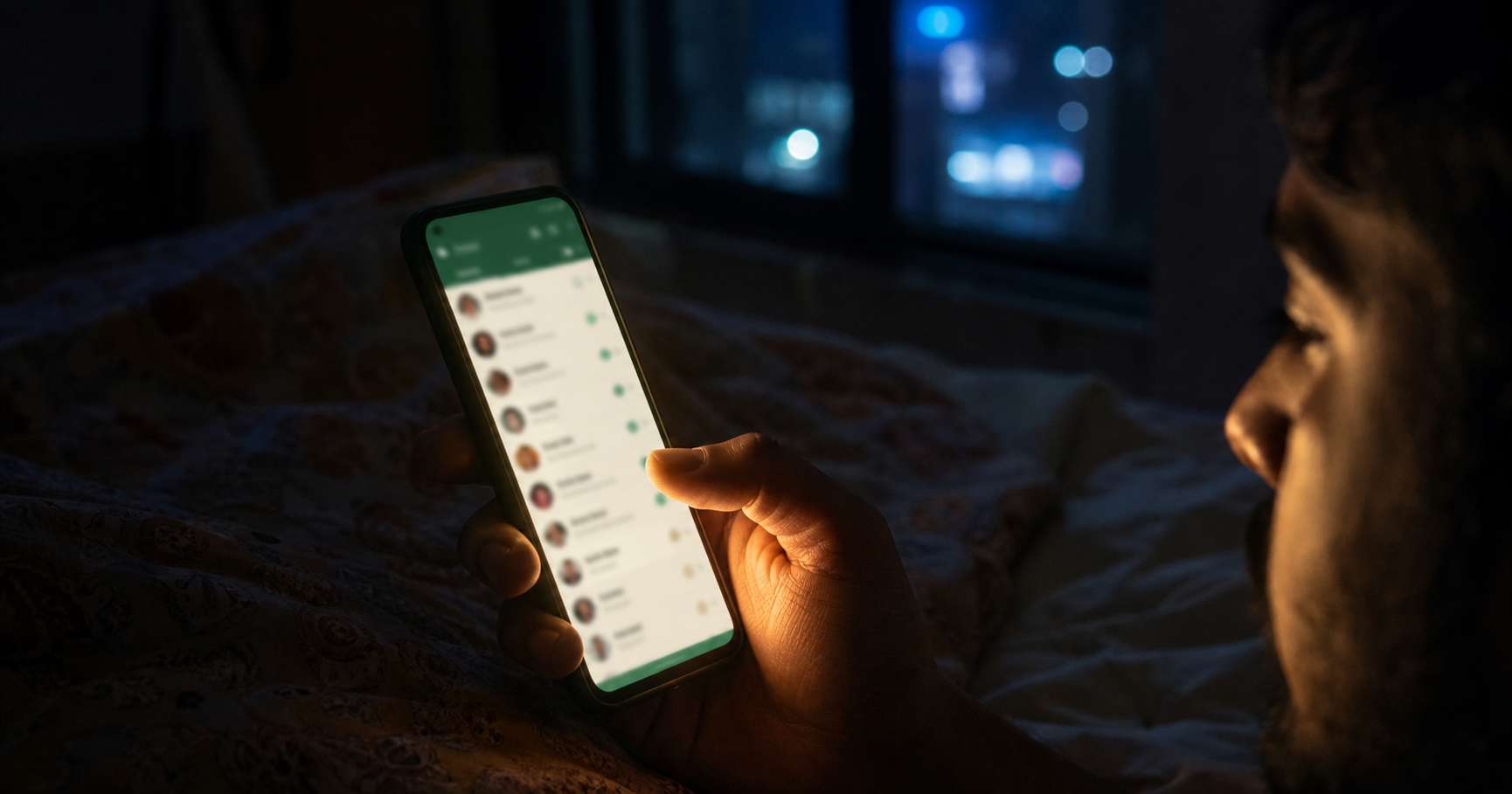
It was probably around 11:30 PM. Maybe later. You were lying in bed, still dressed, phone in hand, doing the thing you do when the quiet gets too loud.
You opened WhatsApp. Scrolled past the family group. Past your college group that only wakes up when someone shares a meme or gets married. Past the three friends who'd pick up but would also ask "kya hua?" in a tone that means you now owe them a full explanation. You kept scrolling. You didn't stop on anyone. You closed the app.
Then you opened Instagram. Watched four stories. Closed it. Opened YouTube. Closed it. Opened WhatsApp again. Same list. Same decision. Same outcome.
Nobody got a message. Nobody got a call. And you put the phone down feeling worse than before you picked it up.
If this has happened to you, this piece is about why. And why it doesn't mean what you think it means.
You have people. That's not the problem.
This is the part that confuses everyone, including you. You're not friendless. You have people who'd come if you asked. People who've shown up before. You could name five people right now who genuinely care about you.
And yet tonight, at the hour when the thing in your chest got heavy enough to notice, not one of those names felt like the right person to call.
That's not a character flaw. That's a filtering problem.
Here's what's actually happening when you scroll and close: your brain is running a rapid cost benefit calculation on every name. Can I say what I actually feel to this person? Will they understand without me having to build the whole backstory? Will they tell someone else? Will they worry too much? Will they try to fix it when I don't need fixing, I just need someone to hear it?
Most names fail at least one of those filters. So you close the app. Not because you don't have people. Because you don't have the right context with any of them for what you need to say tonight.
The 300 contact paradox
Research backs this up. A study found that while over 75% of people are satisfied with the number of friends they have, more than 40% feel they aren't close enough to those friends to say what actually matters. The issue isn't the size of the contact list. It's the depth that's missing.
India is sitting in this exact paradox right now. The country ranks as the second loneliest nation globally in a 2026 survey of 36 countries. Not because Indians don't have relationships. Indian families are large, friend circles are tight, WhatsApp groups are endless. The structures of connection are everywhere. What's missing is the permission to use them honestly.
Because every existing relationship carries rules. With your parents, certain topics are off limits. With your friends, there's a version of yourself you've already established, and deviating from it feels risky. With your partner, some feelings come with consequences. With colleagues, vulnerability is a career risk.
So you carry it. Quietly. And at 11:30 PM, you scroll through 300 names and find zero safe options.
56% of working professionals feel this. Most won't say it.
A survey across 14 Indian firms found that 56% of working professionals openly admitted to loneliness. Another 23% felt it but denied it. That's nearly 8 in 10 people carrying something they can't say to the people around them.
The cities driving this are the same cities where opportunity lives. Bangalore, Gurugram, Pune, Hyderabad. Young people move there for work, leaving behind the social networks they grew up in. They build professional relationships, not personal ones. They spend entire days where the only human interaction happens through screens, delivery apps, and Slack channels.
And here's the part nobody writes about: even when they go home for Diwali or a cousin's wedding, the loneliness doesn't pause. Because the version of themselves that their family knows is two years out of date. The gap between who they are now and who their family thinks they are has grown too wide to cross in a weekend visit.
So they return to their PG room or their 1BHK. And the scrolling resumes.
Why the contact list fails at night
Daytime loneliness and nighttime loneliness are different animals.
During the day, you're occupied. Work gives you a role to play. Colleagues give you surface level conversations. The structure of a day holds you in place. You don't feel lonely because you don't have time to notice.
But between 9 PM and 2 AM, the structure dissolves. The role drops. The things you've been pushing aside all day float to the surface. And now you need to talk, but the people who are available during the day are not emotionally available at night. They're tired. They're watching a show. They're dealing with their own version of this.
This is why Haven's busiest hours are after 9 PM. Not because loneliness is a nighttime thing. Because nighttime is when the distractions stop working and the real feelings show up.
What you actually needed in that moment
Let's be honest about what you were looking for when you opened that contact list.
You weren't looking for advice. If you wanted advice, you'd have Googled it. You weren't looking for someone to tell you everything's going to be okay, because you know that sentence doesn't actually change anything. You weren't looking for therapy either. The thing you're carrying isn't a disorder. It's a Tuesday.
What you wanted was a person. A real one. Someone who doesn't need the backstory. Someone who won't judge, not because they've promised not to, but because they genuinely don't have enough context about your life to judge. Someone who's just there to listen while you say the thing that's been circling in your head since morning.
That's a very specific need. And your contact list, no matter how long it is, wasn't built for it.
Your contact list is a record of the people in your life. It's not a record of the people who can hear you without consequence. Those are two completely different lists. And the second one, for most people, is empty.
The empty list doesn't have to stay empty
The reason you closed WhatsApp isn't because you're bad at relationships or because your friends don't care. Your friends are great. Your family loves you. That's not the issue.
The issue is that the conversation you needed tonight required something your existing relationships can't offer: zero context. No history, no expectations, no shared social circle, no "I'll tell you about it later" hanging over the interaction. Just a clean space to say what's there.
Strangers offer that. Not random strangers on the internet. Not anonymous comment sections. A real person whose only job in that moment is to hear what you need to say. Someone chosen specifically for how you talk, not someone you got assigned to in a queue.
That's what Haven is. Not a replacement for your friends. Not therapy. Not an AI pretending to care. A real human on the other end at 11:30 PM, when your contact list has already failed you.
Because the scroll and close pattern isn't going to fix itself. The names on that list aren't going to suddenly become consequence free. But the conversation you needed doesn't have to wait until someone on that list magically becomes the right person. It can happen tonight.
Haven connects you with a real person to talk to, by chat or call, whenever you need to be heard. No therapy. No AI. Just a real conversation.
Download on the App Store · Get it on Google Play